In the rolling paper industry, the term “booklet” refers to the packaging unit in which paper leaves cut to a defined size are brought together inside a cover. The internal structure of this unit directly determines the production line used, the cutting method, the cover dimensions and the packing layout. The two most common structures in the industry are known as the Interleaving Booklet and the Flat Booklet. In this article, we summarise the technical differences between the two structures, their production flows and their sizing approaches from a corporate perspective.
What does booklet structure define?
Booklet structure defines how the leaves are arranged inside the cover, how they relate to one another and how they are separated from the cover. Even when paper of the same grammage and the same dimensions is used, the way the leaves are arranged calls for a different production line, different cutting tolerances and different cover dimensions. For this reason, when a product specification is prepared, booklet structure is one of the parameters that must be settled first, together with format and leaf count.
Interleaving Booklet structure
In the interleaving structure, each leaf is folded along its longitudinal axis and the folded half of the next leaf is placed inside the fold of the previous one. The leaves thus form a chained sequence: when one leaf is separated from the cover, part of the next leaf is positioned towards the opening of the cover. Because this structure requires leaves to be folded and arranged in a continuous flow on the line, it depends on a fully automated production process.
Production flow
Interleaving booklet production is a continuous process in which paper supplied on reels is processed on the line and converted directly into covered booklets. In broad terms, the flow consists of the following steps:
- Feeding paper from the reel and controlling web tension
- Slitting the paper to the format width
- Applying and drying the gum strip on gummed products
- Folding and interleaving the leaves
- Cutting to leaf length and separating the defined leaf count
- Covering, cover folding and intermediate packing
Interleaving Booklet infrastructure at the NOVEX facility
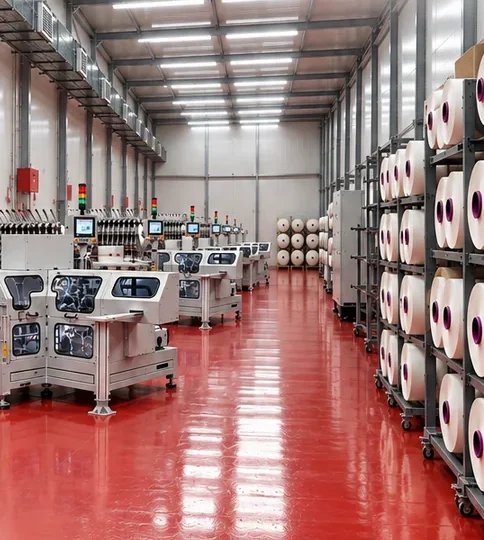
At the NOVEX production facility, Interleaving Booklet production is carried out on three multi-format IMATEC lines. Each line operates at a capacity of approximately 160 booklets per minute. The multi-format design of the lines allows the King Size Slim, King Size Super Slim, Regular, King Size XL and 1¼ formats to be produced on the same infrastructure by changing the line settings.
Flat Booklet structure
In the Flat Booklet structure, the leaves are not folded; they are stacked flat on top of one another and positioned inside the cover as a block. The leaves are separated one by one, like the pages of a notebook, and there is no chained connection between them as in the interleaving structure. As a result, the accuracy of the leaf dimensions and the straightness of the block edges become decisive for product consistency.
Production flow
In Flat Booklet production, the paper is first formed into a stack, which is then cut to the final leaf size. Cutting is carried out on guillotine-type machines that produce a straight, square cut face across the full height of the block. After the cut blocks pass a dimensional check, they are covered and packed.
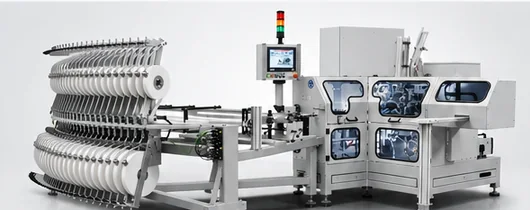
The NOVEX facility has a separate flat booklet production line, an industrial guillotine cutting machine and precision sizing equipment for Flat Booklet production. In this category, paper developed in France with a formulation specific to NOVEX is used, in grammages starting from 12 g/m².
Sizing and cutting tolerances
One of the most significant technical differences between the two structures is the stage at which, and the method by which, the dimensions are determined:
- Interleaving Booklet: Leaf width is set at the slitting stage and leaf length at the cutting unit on the line. A format change is made by adjusting the line settings and changing the relevant parts.
- Flat Booklet: Dimensions are set by cutting the stacked paper with a guillotine. Blade angle, stack height and clamping arrangement directly affect cut quality.
In both structures, the cover dimensions must be consistent with the leaf dimensions and the leaf count. This consistency determines both the flow on the packing line and the dimensional uniformity of the final pack.
Comparative summary
| Feature | Interleaving Booklet | Flat Booklet |
|---|---|---|
| Leaf arrangement | Folded, interleaved | Flat, stacked |
| Production method | Continuous line production from the reel | Guillotine cutting of stacks |
| Stage where size is set | Slitting and in-line cutting | Block cutting |
| Format change | Via line settings | Via cutting size and cover |
| NOVEX infrastructure | 3 multi-format IMATEC lines | Separate flat booklet line, guillotine, sizing equipment |
How does the choice of structure affect the specification?
The booklet structure is chosen by assessing the partner’s target market, existing product range, cover and packaging design, and the legal requirements of the target market together. Once the structure is decided, format, leaf count, grammage and paper type are written into the specification accordingly. You can find the available formats and product types on the Products page and details of the production infrastructure on the Production Infrastructure page.
For technical questions about booklet structure, format and leaf count, you can reach us via the Contact page. All requests are evaluated within the scope of technical capability and applicable legislation.
Need technical information on this topic?
Contact our team for corporate production and partnership enquiries.
This article is provided for corporate and technical information only; it is not advertising or promotion.